
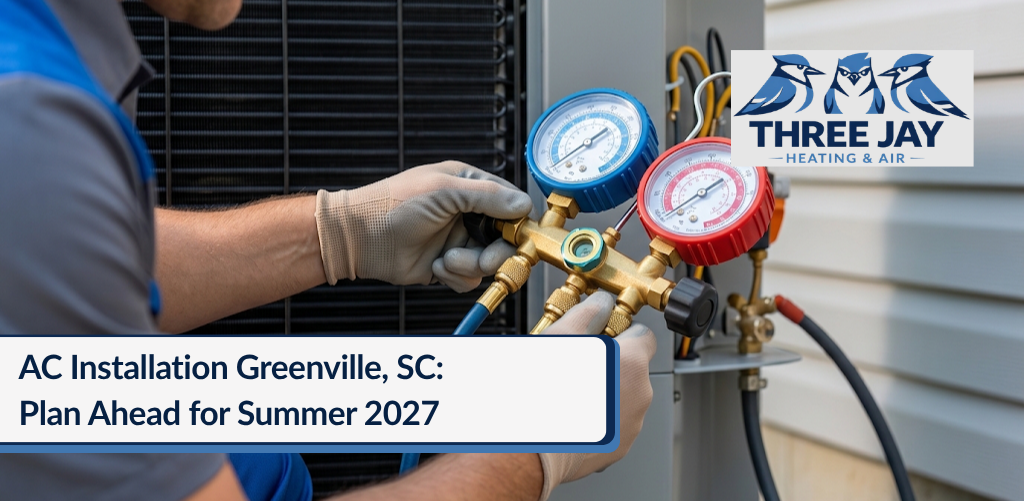
If your air conditioner is more than 10 years old, needs repeated repairs, struggles to cool evenly, or has become noticeably more expensive to operate, planning AC installation before summer 2027 is reasonable. ENERGY STAR specifically recommends considering replacement when an air conditioner is more than 10 years old or requires frequent repairs. An August evaluation lets an HVAC contractor inspect the system after peak-season operation and tell you whether repair or replacement makes better financial sense.
Your air conditioner made it through another Greenville summer. That does not necessarily mean it is ready for the next one.
August is one of the best times to evaluate an aging system because your AC has just spent weeks operating under the kind of heat and humidity that exposes weak compressors, airflow problems, refrigerant issues, and declining efficiency. If you noticed longer run times, warmer bedrooms, rising power bills, strange noises, or another repair call this summer, planning AC installation in Greenville SC before 2027 may give you more control than waiting for a breakdown.
That matters in the Upstate. NOAA climate normals for Greenville-Spartanburg show August carries roughly 380.5 cooling degree days using a 65°F base, which reflects substantial demand for mechanical cooling throughout the month.
This guide explains how to read those late-summer warning signs, compare repair against replacement, understand current AC installation costs, and prepare for a new system without making a rushed decision.
What August Can Tell You About Your Current AC
An AC installation replaces or substantially upgrades the cooling equipment that serves your home. In a typical central system, that may include the outdoor condenser, indoor evaporator coil, air handler or furnace interface, refrigerant piping, controls, thermostat, and related electrical components.
The question is not simply whether your current AC turns on. The better question is how well it performed when Greenville placed the greatest load on it.
Long Run Times
A healthy system may run for extended periods during very hot weather. However, a major change from previous summers can indicate lost capacity, dirty coils, restricted airflow, refrigerant problems, or aging components.
Humidity That Never Feels Controlled
Your air conditioner removes moisture while it cools. If your home reaches the thermostat setting but still feels sticky, clammy, or uncomfortable, the system may be oversized, improperly operating, or losing its ability to manage sensible and latent heat effectively.
Uneven Cooling
Bedrooms that remain several degrees warmer than the rest of the house can point to duct leakage, poor airflow, incorrect equipment sizing, or a system that can no longer meet the home’s load.
HVAC Advice: Do not choose a new system by simply matching the tonnage printed on the old condenser. Professional air conditioning installation should include a load calculation that evaluates the home’s actual cooling demand.
ENERGY STAR also identifies persistent hot or cold rooms, humidity problems, rising energy bills, and frequent repairs as reasons to have aging equipment professionally evaluated.
Those performance clues become even more useful when combined with the warning signs you can observe yourself.
Warning Signs Your AC May Not Make It Through Another Summer
A system does not have to stop cooling completely before AC replacement in Greenville SC becomes worth discussing. Watch for patterns, especially after months of heavy summer use.
- The equipment is more than 10 years old. Age alone does not force replacement, but ENERGY STAR uses the 10-year mark as a reasonable point to begin evaluating central air-conditioning equipment more closely.
- Repairs are becoming routine. One capacitor or drain repair is different from repeated failures involving motors, coils, controls, refrigerant leaks, or the compressor.
- Your energy use has increased without an obvious lifestyle change. Declining performance can cause longer cycles and greater electricity consumption.
- Some rooms never get comfortable. Do not automatically blame the thermostat. Poor duct design, low airflow, equipment capacity, insulation, or aging AC components may be involved.
- Your home feels humid even when it is cool. This commonly overlooked symptom can indicate that cooling and moisture removal are no longer working together effectively.
- You hear new buzzing, grinding, rattling, or hard-starting noises. Mechanical and electrical symptoms deserve inspection before another high-load season.
- The system cools today but struggled during the hottest afternoons. That lost capacity may become much more obvious when next year’s peak temperatures arrive.
Warning: Do not repeatedly reset a tripped HVAC breaker. A recurring trip can indicate an electrical fault that requires professional diagnosis.
If several of these symptoms occurred together this summer, the financial risk of waiting becomes the next question.
What Happens If You Wait Until the System Fails
Waiting is not always wrong. A younger AC with one inexpensive repair may have years of useful service remaining.
The risk increases when an older system is already showing multiple warning signs. A small component failure can leave the system unable to cool during peak heat, while ignored condensate problems can damage ceilings, flooring, insulation, or nearby materials.
There is also a planning cost. Emergency air conditioning replacement in Greenville SC can reduce the time you have to compare equipment, review warranties, evaluate efficiency levels, inspect ductwork, or obtain multiple estimates.
A planned project gives you room to compare options such as:
- A standard-efficiency central air conditioner
- A higher-efficiency variable or multi-stage system
- A heat pump that provides both heating and cooling
- Duct repairs or airflow improvements completed with the new equipment
The refrigerant transition adds another reason to understand what you own. EPA rules now restrict new residential and light-commercial systems that use refrigerants above the applicable 700 GWP limit. New R-410A systems can no longer be assembled and installed in 2026, although R-410A components can still be produced and sold for servicing existing equipment.
Cost escalation perspective: A manageable repair today can become a substantially larger expense if continued operation damages a compressor or allows condensate leakage to affect the home. The exact cost depends on the failed component, equipment age, and surrounding damage.
If your AC is already making you question another summer, an inspection now can turn an emergency decision into a planned one.
Need an Answer Before You Commit?
If your system struggled through August, Three Jay Heating & Air can inspect its condition and explain whether repair or AC installation is the stronger option. Ask for a clear, upfront estimate so you can compare the cost of keeping the current equipment against replacing it before summer 2027.
DIY Checks vs Hiring a Licensed HVAC Contractor
You can gather useful information yourself before scheduling an AC installation estimate, but there is an important line between observation and mechanical work.
What You Can Handle
| Homeowner Check | What You Are Looking For |
|---|---|
| Replace or inspect the air filter | Heavy dirt or restricted airflow |
| Check thermostat settings | Cooling mode, reasonable temperature setting |
| Inspect supply vents | Closed or blocked registers |
| Look around the outdoor unit | Leaves, heavy vegetation, visible debris |
| Review previous repair invoices | Repeat failures or growing repair frequency |
You can also record which rooms feel uncomfortable and whether the AC struggles at certain times of day. That information helps the technician diagnose the entire system.
When You Must Call a Pro
Refrigerant recovery, evacuation, charging, compressor work, high-voltage electrical repairs, equipment replacement, and many system modifications belong with qualified technicians.
South Carolina’s Residential Builders Commission states that residential HVAC work exceeding $500 requires an appropriate license. Greenville County also states that HVAC work requires permits, and the City of Greenville provides a mechanical permit specifically for heating, air conditioning, ventilation, and related gas connections.
Do Not Do This: Never open a refrigerant circuit, bypass electrical safety controls, or install mismatched indoor and outdoor equipment yourself.
Once replacement becomes the right decision, professional HVAC installation services should follow a much more detailed process than swapping one box for another.
How Professional AC Installation Works
A well-planned AC installation in Greenville begins before the old condenser is disconnected. The installer should verify that the new equipment actually matches your home.
Step 1: Inspect and Calculate the Cooling Load
Typical planning time: 30 to 60 minutes
The contractor evaluates square footage, insulation, windows, orientation, duct conditions, air leakage, and other factors. A Manual J-style load calculation helps determine appropriate capacity instead of assuming the old system was sized correctly.
Step 2: Check Ductwork, Electrical Service and Equipment Compatibility
Typical planning time: 30 to 60 minutes
The technician evaluates airflow, return-air capacity, drain configuration, electrical requirements, thermostat compatibility, and the existing furnace or air handler.
Step 3: Remove the Existing Equipment
Typical field time: 1 to 2 hours
The contractor safely recovers refrigerant where required, disconnects the old equipment, protects the work area, and prepares the installation surfaces.
Step 4: Install the New System
Typical field time: several hours
The condenser, coil or air handler, refrigerant lines, drain components, electrical connections, and controls are installed or adapted as necessary.
Step 5: Evacuate, Charge and Commission the System
The installer evacuates the refrigerant circuit, confirms charge and airflow, checks static pressure, verifies temperature performance, and tests operating controls.
Step 6: Walk You Through the New Equipment
You should receive operating instructions, warranty information, filter guidance, and maintenance recommendations.
A straightforward central AC installation commonly fits within one working day. More complex ductwork, access, electrical, or system modifications can extend the project into another day. A Greenville-area installation company similarly notes that standard replacements often complete within a day while more complex projects may require additional time.
That brings most homeowners to the biggest practical question, price.
2026 AC Installation Cost in Greenville SC
There is no responsible way to quote the exact cost of new air conditioning without seeing the home. Capacity, efficiency, ductwork, electrical upgrades, equipment configuration, accessibility, and permit requirements all affect the final number.
What Changes the Cost of a New AC System?
- Cooling capacity and equipment size
- SEER2 efficiency
- Single-stage, two-stage, or variable-speed operation
- Duct modifications
- Refrigerant line replacement
- Electrical upgrades
- Permit and inspection requirements
- Thermostat and control upgrades
- Installation accessibility
- Manufacturer and warranty level
South Carolina falls within DOE’s Southeast regional efficiency standards. Split-system AC units below 45,000 Btu/h generally require at least 14.3 SEER2, while units at or above that capacity use a 13.8 SEER2 minimum.
Another important 2026 update concerns incentives. The federal Energy Efficient Home Improvement Credit ended for property placed in service after December 31, 2025. Greenville homeowners should not assume a 2026 central AC installation qualifies for the former federal 25C credit.
Utility rebates may still be available. Duke Energy’s South Carolina Smart Saver program lists HVAC rebates for eligible upgrades completed through participating contractors. Eligibility and rebate amounts should be checked before purchasing equipment.
A legitimate AC installation estimate should clearly identify equipment, labor, permit handling, removal of old equipment, warranty terms, and any exclusions. Ask about payment or financing options before approving the work rather than assuming they are available.
Once you understand the price, compare the contractor with the same care you use to compare equipment.
How to Choose an HVAC Installation Company in Greenville
Searching AC installation near me can produce dozens of companies. The first result is not automatically the best contractor for a major mechanical system.
Use this checklist before signing:
- Verify the contractor’s South Carolina HVAC license through the South Carolina Department of Labor, Licensing and Regulation.
- Confirm current general liability insurance and any applicable bonding.
- Ask who will obtain the required mechanical permit.
- Request the complete model numbers for the proposed indoor and outdoor equipment.
- Ask whether a load calculation will be performed.
- Ask how airflow and static pressure will be tested.
- Get labor and equipment warranties in writing.
- Ask about EPA refrigerant-handling credentials and technician training.
- Review recent installation reviews, not only repair reviews.
- Compare scope, not simply the bottom-line price.
South Carolina’s licensing agency states that residential HVAC work over $500 requires licensure, giving homeowners a clear verification point before hiring.
For social proof, examine Google, HomeAdvisor, BBB, Yelp, and Nextdoor patterns. Look for detailed reviews discussing communication, cleanliness, punctuality, diagnosis, installation quality, and follow-up.
Three Jay Heating & Air’s HomeAdvisor profile currently lists free project estimates, warranties, a South Carolina trade license entry, and a 5.0 rating from eight reviews. Because third-party license and insurance information can change, homeowners should still verify credentials directly before work begins.
Local companies also have an advantage when they routinely work with Greenville-area permitting, climate conditions, crawlspaces, duct configurations, and local utility programs.
Timing your decision can matter almost as much as choosing the contractor.
Why Late Summer Is a Smart Time to Plan for 2027
August gives you real performance data. You have just watched the system operate through weeks of heat, humidity, afternoon demand, thunderstorms, and long cooling cycles.
That makes late summer useful for planning air conditioner installation before another peak season.
Pro Tip: Write down every issue you noticed this summer before the weather cools. Include uncomfortable rooms, unusual sounds, repair calls, thermostat problems, high bills, and days when the system could not maintain temperature.
A simple late-summer plan looks like this:
August and September 2026: Have an aging or unreliable system inspected while summer-performance problems are still easy to describe.
Fall 2026: Compare repair and replacement economics, system types, efficiency ratings, warranties, and duct recommendations.
Winter or spring 2027: Complete planned HVAC system installation before peak cooling demand if replacement is the chosen path.
Preventive maintenance still matters if you keep the existing system. Change filters as needed, keep supply and return vents open, keep the outdoor unit clear, and schedule professional maintenance before heavy cooling returns.
The financial advantage is not that off-season equipment is guaranteed to be cheaper. Pricing changes with equipment, inventory, labor, and manufacturers. The advantage is decision flexibility.
Instead of choosing whatever is available after a July breakdown, you can evaluate the right capacity, efficiency, warranty, controls, and installation scope beforehand.
Greenville’s climate makes that preparation particularly relevant.
Greenville and Upstate South Carolina Factors That Matter
A good AC installation Greenville SC plan should reflect where the equipment will actually operate.
Heat and Humidity
NOAA’s 1991 to 2020 normals for Greenville-Spartanburg show August daily high temperatures starting around 90°F early in the month, with significant cooling demand continuing through the season. The same dataset reports about 380.5 August cooling degree days at a 65°F base.
That means equipment selection should consider both temperature control and moisture removal.
Permits and Code Compliance
Inside the City of Greenville, the city’s Mechanical Permit Application covers heating, air conditioning, ventilation, and associated gas service connections. Greenville County separately states that HVAC work requires a permit.
This is one reason extremely low AC installation bids deserve scrutiny. Permit handling, proper equipment matching, electrical work, commissioning, and cleanup all require time.
The 2026 Refrigerant Transition
EPA rules have changed the new-equipment market. New residential systems installed in 2026 must comply with current refrigerant GWP restrictions. R-454B and R-32 are examples of lower-GWP refrigerants being used by manufacturers, while R-410A remains available for servicing existing legacy systems.
Upstate Service Areas
Homeowners comparing AC installation Greer, or AC installation Taylors should still verify the permit authority and utility serving their exact address.
Duke Energy customers should also check current Smart Saver HVAC rebate eligibility before selecting equipment.
These local factors help explain why an in-home assessment beats an online price calculator.
Homeowners Also Ask About AC Replacement
How long should an air conditioner last in Greenville SC?
There is no exact expiration date for central AC equipment. Maintenance, installation quality, run time, sizing, weather exposure, and repair history all matter. ENERGY STAR recommends considering replacement once a heat pump or air conditioner is more than 10 years old, particularly when repairs and energy bills are increasing. In Greenville’s long cooling season, system condition matters more than age alone.
Should I replace my AC even if it still works?
Sometimes. A working AC does not automatically need replacement, but repeated repairs, declining comfort, humidity problems, high operating costs, and advanced age can justify planning ahead. Getting an AC installation estimate before failure gives you information without committing you to replacement.
Is fall a good time for AC installation in Greenville?
It can be. Fall often gives homeowners more planning flexibility because the cooling system is no longer under continuous peak demand. The better reason to consider fall AC installation is that you can make the decision based on how the system performed during summer rather than waiting for an emergency next year.
Should I replace my AC and furnace together?
Not automatically. The answer depends on equipment age, system compatibility, blower condition, efficiency goals, controls, and whether the furnace and new coil can form an approved matched system. If both pieces are aging, comparing the cost of coordinated HVAC installation against separate projects is worthwhile.
Frequently Asked Questions
Q: How much does AC installation cost in Greenville SC?
A: A July 2026 Greenville-area cost model places full HVAC or AC replacement between roughly $3,602 and $11,525, with a modeled typical project around $7,564. Your actual price depends on capacity, efficiency, ductwork, electrical requirements, equipment selection, access, permits, and installation scope. An in-home AC installation estimate provides a more useful number than an online average.
Q: How long does central AC installation take?
A: Many straightforward replacements can be completed within one working day when existing ductwork, electrical infrastructure, access, and system configuration are suitable. Projects requiring duct changes, electrical modifications, difficult equipment access, or additional corrective work may take longer. Your written proposal should state the expected schedule.
Q: Does AC replacement require a permit in Greenville?
A: HVAC work generally requires permitting. The City of Greenville specifically provides a Mechanical Permit Application for heating, air conditioning, ventilation, and related gas work. Greenville County also states that HVAC work requires a permit. Ask the contractor who will obtain and close out the permit for your property.
Q: Does a new air conditioner qualify for a federal tax credit in 2026?
A: The previous federal Energy Efficient Home Improvement Credit does not apply to qualifying property placed in service after December 31, 2025. Homeowners considering AC installation in 2026 should instead check current utility, manufacturer, state, or other incentive programs before purchasing.
Q: What warranty should I expect with a new HVAC system?
A: Warranty coverage varies by manufacturer and contractor. Ask separately about the manufacturer’s parts warranty, compressor coverage, registration requirements, and the installer’s labor or workmanship warranty. Get every warranty term in writing and confirm whether annual maintenance is required to preserve coverage.
Q: What should I receive after AC installation is finished?
A: You should receive model and serial numbers, warranty documentation, thermostat instructions, maintenance guidance, permit or inspection information when applicable, and a clear explanation of filter requirements. The technician should also demonstrate that the system cools properly before leaving.
Ready to Know Whether Your AC Has Another Greenville Summer Left?
If your air conditioner struggled through August, you do not have to wait for a breakdown to find out what comes next. Three Jay Heating & Air can evaluate your existing equipment, explain whether repair or AC installation makes more sense, and provide a clear estimate based on your home.
Serving Greenville, Greer, Simpsonville, Mauldin, Taylors, Spartanburg and surrounding Upstate South Carolina communities, Three Jay Heating & Air focuses on straightforward recommendations, quality workmanship, and helping homeowners understand what they are paying for.
Book your AC installation estimate before summer 2027 planning gets urgent.